 (1)__largepreview__.webp)
2026 04 12 - What If Jesus Didn't Rise? - Engel
Alleluia. Alleluia.
Grace, mercy and peace be unto you from God our Father and from our Lord and Savior, Jesus Christ. Amen. Well, it's been a good several weeks for Christianity, those of us who took the time to walk through the 40 days of Lent, preparation for what was to come to Jesus through his walk to the cross. And then there was this Palm Sunday experience that we had several weeks ago when we had a festive celebration of Jesus entry into Jerusalem. That was followed by Maundy Thursday when Jesus washed the disciples feet and gave us the Lord's Supper as a sacrament to the church.
And then there was that somber day called Good Friday when we acknowledged the death of Jesus on the cross. And then it all culminated last week. Last Sunday when we celebrated Easter, we had this marvelous celebration. We sang our hallelujahs again. We had our breakfast and we sang our joyous songs in praise to God for the resurrection of his only son.
And what a celebration it was. And. And it continues. But what if Jesus did not rise?
What if it was all a hoax? What if we have been duped all these years with a fairy tale to beat all fairy tales? What if we have been snookered into believing a conspiracy?
What if it's all just one big whopper of a lie?
What if Jesus didn't rise from the dead?
Some years ago, back in the 1970s, there was a project called the Jesus Seminar. It was a gathering of liberal theologians and scholars, scholars who were sifting through the Gospels, reading all the lessons, the teachings of Jesus and the miracles of Jesus and all the deeds that he'd done. They were trying to sift through and separate fact from fiction, history from legend. They would discuss the words, discuss the deeds of Jesus, discuss the miracles that Jesus supposedly performed. And then they would vote.
They would try to decide whether this was truly something that happened, something that Jesus did say, or was it a creation of the early church. And after their discussion, they would vote.
Well, their final report was not very encouraging. They determined that most of the words that we read in the gospel attributed Jesus were not really spoken by him, but were a creation of the early church. And they discarded most of his works, most of his miracles that they shoved them aside and they just couldn't believe them. They just unbelievable to them. And then they finally got around to discussing the resurrection.
Did Jesus really rise from the dead as the Gospels declare and as all of Christianity has believed for all of these years?
Their vote was 24 to 1 against the resurrection.
The truth is, people have always had A problem with the resurrection. They've always struggled with Easter. What really happened on that Easter Sunday 2000 years ago in Jerusalem? Did Jesus really rise from the dead? Well, it may surprise you, but there were doubters and skeptics from the very beginning.
In fact, Matthew records for us on that very first Easter a conspiracy. We often overlook this part of the Gospel, but let me read it to you. This takes place after the women had been to the tomb on Easter Sunday, and they were going back to tell the disciples. And this is what Matthew writes. As the women were on their way to tell the disciples, some of the guards went into the city and told the leading priests what had happened.
A meeting with the elders was called, and they decided to give the soldiers a large bribe. They told the soldiers, you must say Jesus. Disciples came during the night while we were sleeping, and they stole the body. If the governor hears about it, we'll stand up for you so that you won't get into any trouble. So the guards accepted the bride and said what they were told to say.
Their story spread widely among the Jews, and they still tell it today.
Earlier, in Matthew's gospel, he records that it was the Jews who asked Pilate to place guards around the tomb because they remembered that Jesus had said on the third day he would rise again.
The ironic fact is that on that Saturday between Good Friday when Jesus died and Easter Sunday when he rose from the dead, the only people worried about the resurrection were the people who put Jesus to death in the first place. The guards were there because the Jewish leaders feared that something strange might happen at the tomb. So the first Easter conspiracy was hatched before the resurrection, and it was consummated afterwards by bribing the Roman guards. But that was only the first of a long line of attempts to cover up the truth about Easter. And over the centuries, skeptics have concocted a number of theories to explain the resurrection of Jesus.
So I want to share with you some of those conspiracies. Now, the first one is that Jesus really didn't die. This is called the swoon theory. Some skeptics have proposed that Jesus actually survived the crucifixion, that on the cross he kind of fainted, he went into unconsciousness, he swooned. And then when he was in the tomb, in the coolness of the tomb, he revived his body.
He came back to life on Easter Sunday and fooled everyone into thinking that he had risen from the dead. It sounds pretty good, but it doesn't make sense, because the whole purpose of crucifixion was a brutal, agonizing death. And no one could possibly survive the beating and the scourging and the torture of crucifixion and being pierced by a spear. The Romans, you see, they were good at killing. This was their specialty.
They knew the difference between a dead man and an unconscious man hanging on the cross. And besides, if Jesus had somehow survived after so much physical abuse and torture, how did he roll the stone away and then give the appearance on Sunday morning of a prayer? Perfectly healthy body. The theory just doesn't hold war. Then there's this.
This theory that the disciples stole the body. But why would the disciples steal the body? All the Gospel writers agree that the disciples were not expecting a resurrection when the women first went to the tomb on that Sunday morning. They were expecting to anoint a dead body, not to see a risen Lord. And besides, how do you explain the amazing transformation of the disciples from the insecure cowards before the resurrection to the flaming evangelists that they became afterwards?
And why did they all go to their deaths proclaiming Jesus resurrection? Men might die for a myth that they wrongly believe, but it is impossible to think that they would willingly go to their death for something they knew was a lie. Then how about this theory that the Jews stole the body? This is a plausible theory, except for one fact. If the Jews had stolen the body, all they would have had to do when the Christians said that Jesus had risen from the dead was to roll out the dead body.
End of story. Besides, why would the Jews steal the body? They wanted to keep Jesus to the tomb at all costs. Then there's the theory that the disciples or the Romans stole the body. This makes absolutely no sense when you think about it, because the Romans weren't worried about Jesus in any way.
They weren't worried about a missing body like the Jews were. They weren't mourning a dead leader like the disciples were. As far as they were concerned, Jesus was just another dead Jew and they had no reason to tamper with the body.
One theory says the body of Jesus just disappeared. This is called the UFO theory.
But what does that mean? Bodies don't just disappear. Something had to happen to that body. A disappearing body still doesn't explain why the early Christian church unanimously believed that Jesus had risen from the dead. And then there's this theory, mass hallucination.
The theory is that perhaps many of the early Christians suffered some kind of mass psychosis that caused all of them to have visions of hallucinations that mistook it for a risen Christ.
This is hard to believe difficult to accept when you realize that two people hardly can have a vision that is even remotely similar, much less identical, because visions tend to be intensely personal. But Jesus appeared many times to many people over a 40 day period. And at one time he appeared to over 500 people at one time. And it strains our belief to think that 500 people would have seen the same vision at the same time. Plus, you still have that pesky question about the body.
If the resurrection was a vision, then what happened to the body? And finally, there's this theory that the Church just made up the story. And this is the current position of most liberal theologians and scholars. It actually combines several of the theories that I've already explained to you. But like all the others, it stumbles over some hard facts.
First, again, what happened to the body? If it simply rotted in the grave or was devoured by some wild dog, surely the early Christians would have known of that fact, or the Jews would have used it to debunk Christianity. And again, why would the disciples suffer and die? And how do you explain the unanimous testimony of all of Christianity for all of these years that Jesus did indeed rise from the dead? It seems like it takes far more faith to believe this theory than it does to accept what the Gospels have declared for us.
So these are the theories that have been hoisted upon us to try and explain away the crucifixion. But let me share with you why I believe that Jesus actually rose from the dead. First of all, Jesus predicted that he would rise from the dead because he was the Son of God. He knew about things that were happening. He knew about his coming death in Jerusalem, and he also knew about the Resurrection.
In John chapter two, he said he would be raised on the third day. Although his disciples did not understand it at that time, In John chapter 10, he plainly said that he had the power to raise up his life and to lay it down again, or lay it down again and raise it up. And then at that moment, when Peter declared, you are the Christ, you are the Son of the living God, it was then that Jesus told his disciples that he had to go to Jerusalem. He must go to Jerusalem. He must be put to death at Jerusalem.
And then he would rise from the dead on the third day. Jesus predicted that this would happen. Secondly, Jesus really did die. It was the truth. The Romans were experts at killing.
Everything they did to a victim was calculated to make him suffer unbearable pain and to end up in dying and antagonizing death. Jesus actually died. No one could have suffered, survived what he suffered. Jesus was dead when they took him down from that cross.
Thirdly, his body was buried in a tomb. The gospels note that Jesus body was taken down and hurriedly prepared for burial in the last few moments of that day because Jewish law prevented anyone to touch a dead body on the Sabbath. So he was buried in this newly dug tomb prepared by Joseph of Arimathea. And Joseph of Arimathea. And Nicodemus along with the women, prepared the dead body for burial.
And it was afterwards that Pilate ordered the tomb sealed and then placed a squad of soldiers in front of the tomb and a stone to be rolled in front of it. A precaution against anyone stealing the body. In the fourth place, the disciples didn't expect a resurrection. In my mind this is one of the most telling points. Because even though Jesus had predicted his resurrection many times to the disciples, somehow that truth simply didn't sink in.
Either they didn't understand it or or they didn't want to think about it what it implied, or they just forgot about it in the emotion of watching Jesus die. But all four gospels make it very clear that before the crucifixion, none of the disciples understood that Jesus referenced about the resurrection. And then also here is that the first people to see Jesus after his resurrection were women. Perhaps in our modern culture today we don't appreciate the significance that it was women who first came to the tomb. No 1st century fiction writer would have put the women arriving at the tomb first.
Because women were not considered to be believable. They were not reliable witnesses. The only reason to say that women saw Jesus first was because they actually did see Jesus first. No one would have made up such a strange detail as that. Then we have this reason.
No one believed the resurrection at first. No one believed the first reports from the women. And discounting what the women said to them, Peter and John, the disciples decided to check out the tomb for themselves. Remember, they ran to the tomb. And remember the disciples went into hiding after Friday because they feared for their own safety.
The last thing that they expected on Sunday morning was a resurrection. In the beginning, it wasn't just Thomas who had doubts it, it was all of them. None of them believed the early reports of Jesus resurrection. And they all had to be convinced over and over again that Jesus had indeed risen from the dead. Then there's this.
The Jews tried to cover it up. Why try to cover up the resurrection if the body's still in the grave? Why would the Jews do that? The COVID up and the payoff to the Romans. Made it, made it sense, like it was really empty and otherwise they just tried out the dead body.
When the resurrection story came out, all they do is roll out the body and they prove the Christians wrong. So the Jews tried to cover it up. Then this is the issue of the stone, the stone being rolled away. And I think it's a big deal because the stone itself was no small thing. It's perhaps 3 to 6ft in diameter and weighed up to 2 tons.
It would have taken several good sized men to have rolled that stone away. And then there was the fact of the seal. That seal could only have been broken by a Roman official. To do so would have been punishable by death. So who rolled the stone away?
The disciples? The guards would have stopped them. The Jews? Same thing. The guards would have stopped them.
The Romans, they had no reason to roll the stone away. They had no motivation. Who would risk death to do such a thing? So who rolled the stone away? The scriptures tell us that God did because he's the one that raised Jesus from the dead.
Then what about the grave clothes? The grave clothes were still in place in the tomb. When John wrote his version of those Sunday morning events, he included the fascinating note that when he and Peter entered the tomb, they found the grave clothes folded, lying in place with the linen headcloth folded next to it. How do you explain that? If there were grave robbers, they would have just snatched the body with clothes and all without unwrapping it.
Or if they had unwrapped it, they would just thrown the clothes or the sheets aside. No one steals a body and then rewraps the grave clothes. Then there's this. No one ever found the body.
This ultimately is the fundamental issue. The Jews never produce a body. In fact, they concocted the first Easter conspiracy precisely because they didn't know what happened to it. And the Romans went along with the conspiracy because they didn't know what happened to it either. If anyone, anyone at all had produced that body of Jesus, the entire Christian movement would have gone the way of many other short lived religions across the centuries.
No one ever found the body. The skeptic simply cannot explain the answer to that question. What happened to the body? Then you have this. Jesus appeared to so many people.
Taking the Gospels together with first Corinthians, you get a list like this. He first appeared to the women at the tomb and then he appeared to Peter and John. Then he appeared to the disciples on the road to Emmaus. Then he appeared to the disciples in the upper room. Then a week later he appeared to the disciples again in the upper room with Thomas, and later to the disciples in Galilee.
And somewhere along the way, he appeared to 500 people at once. When you take all these together, it is an impressive list of people. And it is impressive enough that it cannot just be dismissed out of hand. And writing some 30 years later, Paul commented that most of the people who saw the risen Christ were still alive and were ready to give testimony to what they had seen. How about what we read today in our Gospel lesson?
That Jesus showed his hands, his wounds to Thomas. When Jesus appeared to Thomas a week after the resurrection, he offered that ultimate proof. He spread his hands to Thomas and he said, touch my wounds. See for yourself. And when Thomas saw the wounds, he knew.
He knew at last that it must be true. How about this one? He ate. Jesus ate with the disciples. Luke tells us that Jesus ate broiled fish.
And in the presence of the disciples, a ghost doesn't eat fish. A dead man doesn't eat fish. Then he stayed with them for 40 days. 40 days, that's a long time. If Jesus had only appeared once or twice, we might have some fudging that we could do there.
But Jesus showed himself alive according to Acts with many infallible proofs. He stayed long enough to convince his followers that he indeed come back from the dead. And finally, this one really gets to me. And that is the way the disciples were transformed.
Before that Sunday, the disciples were unsure. They were timid, they were doubting, and in general, they were a lackluster bunch. But afterwards, look what happened to the disciples. To a man, they were utterly, radically, completely transformed. They were quite literally new men.
Suddenly, these timid souls became 1st century Billy Grahams, totally dedicated to spreading the good news of Jesus Christ and his resurrection. Even being persecuted didn't stop them. Opposition didn't faze them. Hatred didn't intimidate them. The hardships that were put against them did not slow them down.
Even the threat of martyrdom did not intimidate them. But they became the dynamos of Christianity, the dynamos of Christian evangelism. In the words of the Bible, they went everywhere preaching the gospel. And these were the men who would eventually turn the world upside down. What made the difference?
The only possibility is that these men met the risen Savior and he changed their lives forever. The resurrection became the centerpiece of their preaching. And they all died testifying to the reality of the resurrection. Of the eleven original disciples, not including Judas of course, plus Paul, they all died violent deaths for their faith, with one exception. John, who spent his final years in exile on the island of Patmos.
And beyond that, thousands of Christians through the years have died because of persecutions. Why would men or women die for a myth? Why would they die for a legend? Why would the apostles die for Christ if they knew he had not risen from the dead?
So I've shared with you why I believe Jesus rose from the dead and the reason why millions and millions and millions and millions of Christians unite every Easter to proclaim that wonderful truth. But at this point, we need to recall the words of Jesus to Thomas in our Gospel today, when he said, stop doubting and believe. Because at every point every person has to declare where they stand.
What about you? How has the conviction of Christ's resurrection affected your life?
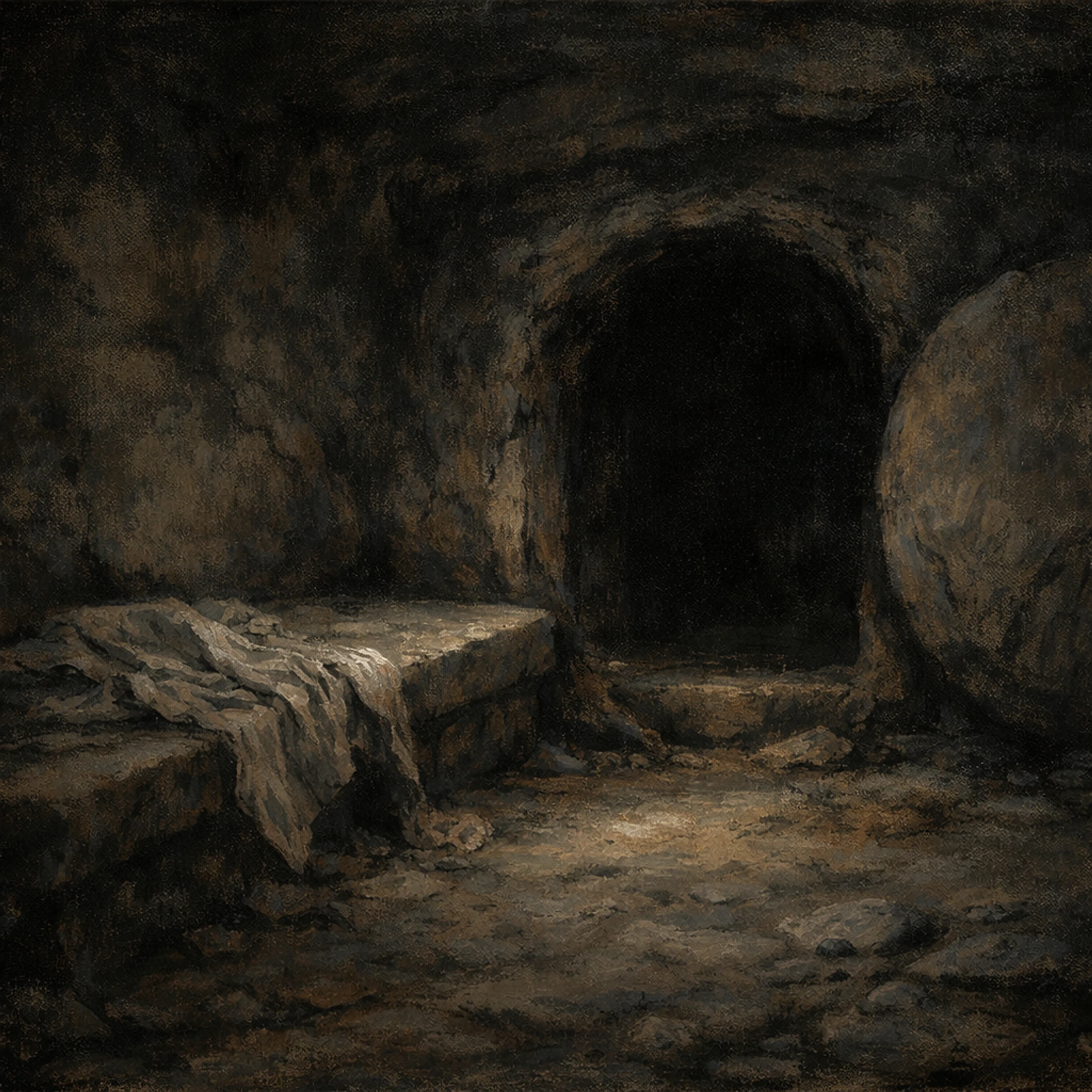
In 1992, I made my trip to the Holy Land. And while there, I spent some time in the garden tomb, the spot believed by many to be the actual place where Jesus body was laid after he was crucified. The place is actually a beautiful garden. It's built over an old Roman aqueduct. And as you enter into the tomb to the garden tomb to the left is a typical first century tomb that is dug out of the hillside.
And there's a trench that is in front of that opening, which was apparently designed for that stone to be rolled in front of the tomb. Because the opening to the tomb is very small, I had to duck down to go inside. And for a few seconds I couldn't see anything. It was dark until my eyes adjusted to the darkness and then I was able to easily make out two chambers. There's a visitor's chamber where we would stand for as the mourners.
And then there was the chamber that was prepared for two bodies, but only one of them had been finished. The other ledge had never been finished for some reason. But as you look at the chamber, you can see the faint markings that were left by Christians from previous pilgrimages who came through there centuries earlier to recognize the place where Jesus lay. But there was no body. The garden tomb was empty.
And as I exited back into the sunlight, my eyes adjusting to the sun, my eyes fastened on a wooden sign to the right of the exit that said, why seek ye the living among the dead? He is not here, for he is risen, as he said. On this Sunday after Easter, I, and I trust you also are happy to declare those ancient words once again. Because the tomb really is empty. Because Jesus Christ really did rise from the dead.
And because he rose, we too shall rise. That's what makes the difference, that Jesus rose And so let the people of God rejoice. He is risen. He is risen indeed. Hallelujah.
Amen.
Now may the peace of God which passes all understanding, keep your hearts and your minds in Christ Jesus now and forevermore. Amen.